Free preview
117 lessons
Essential Python for Data Science and ML
Free preview
Essential Python for Data Science and ML · 117 lessons
Learn Python properly - from basics to ML-ready
No surprise gaps
Actually remember it
Skip what you know
One subscription. All learning paths included.
Our content is best on a larger screen
Variables and object references
Variables hold references to objects
Explanation
In Python, variables don't store data directly - they hold references to objects that contain the data.
x = [1, 2, 3]
This means x references a list object in memory:
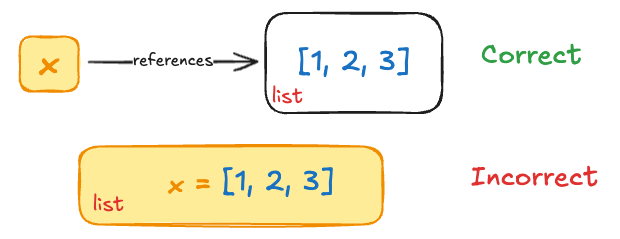
The bottom shows the incorrect mental model - x isn't a box containing values.
Why this matters
Let's explore why we need to care about this with an example.
x = [1, 2, 3]
y = x
x.append(4)
print(y)  # Output: [1, 2, 3, 4]
Here's what happens:
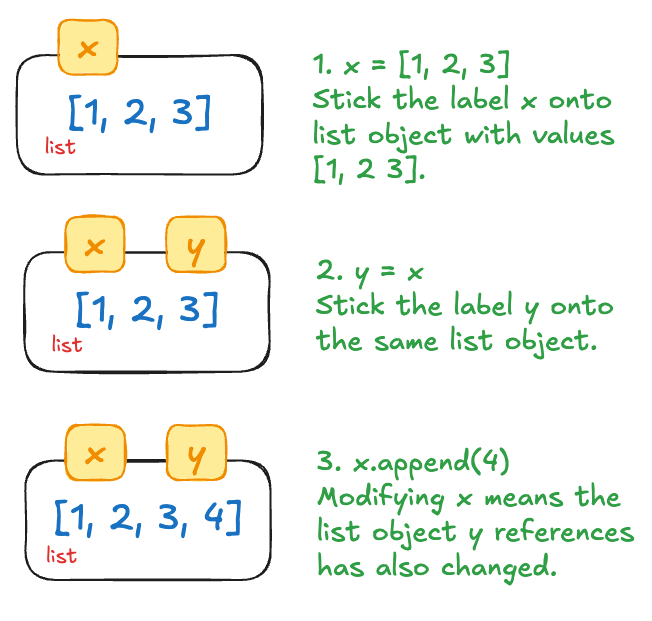
x = [1, 2, 3]creates a list object andxreferences ity = xmakesyreference the same list (no copy is made)x.append(4)modifies the list- Printing
yshows the change - because both variables point to the same object
When we assign y = x, we're binding y to the same object - not copying it. Think of variables as "labels" attached to objects:
Warning
Be careful - modifying a mutable object through one variable affects all variables referencing it.
Info
This behaviour occurs with mutable objects like lists. With immutable objects (strings, tuples), we can't modify the object itself - we can only reassign the variable to a new object.
Practice questions
4 questions
Without writing code, what will the following code output?
x = [5, 6, 7]
y = x
x.append(8)
print(y)
Select the correct answer:
+ 3 more questions
Using id() to inspect object references and memory location
Explanation
In Python, every variable holds a reference to an object, and each object is stored at a particular location in memory.
The id() function returns an object's unique identifier (its memory address):
x = [1, 2, 3]
print(id(x))  # Output: e.g. 4402858432
If two variables reference the same object, they share the same id:
y = x
print(id(x))  # Output: 4402858432
print(id(y))  # Output: 4402858432 (same!)
This confirms x and y are labels pointing to the same object in memory.
Practice questions
4 questions
Which of the following statements about the id() function in Python is true?
Select the correct answer:
+ 3 more questions