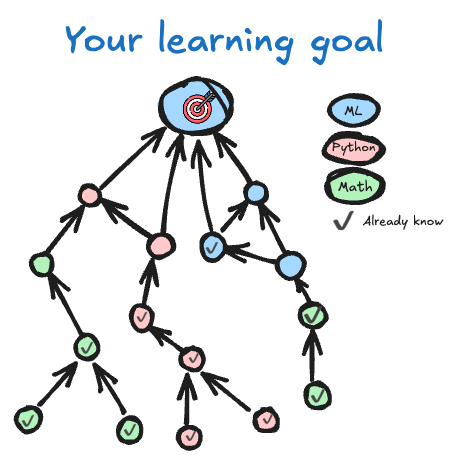
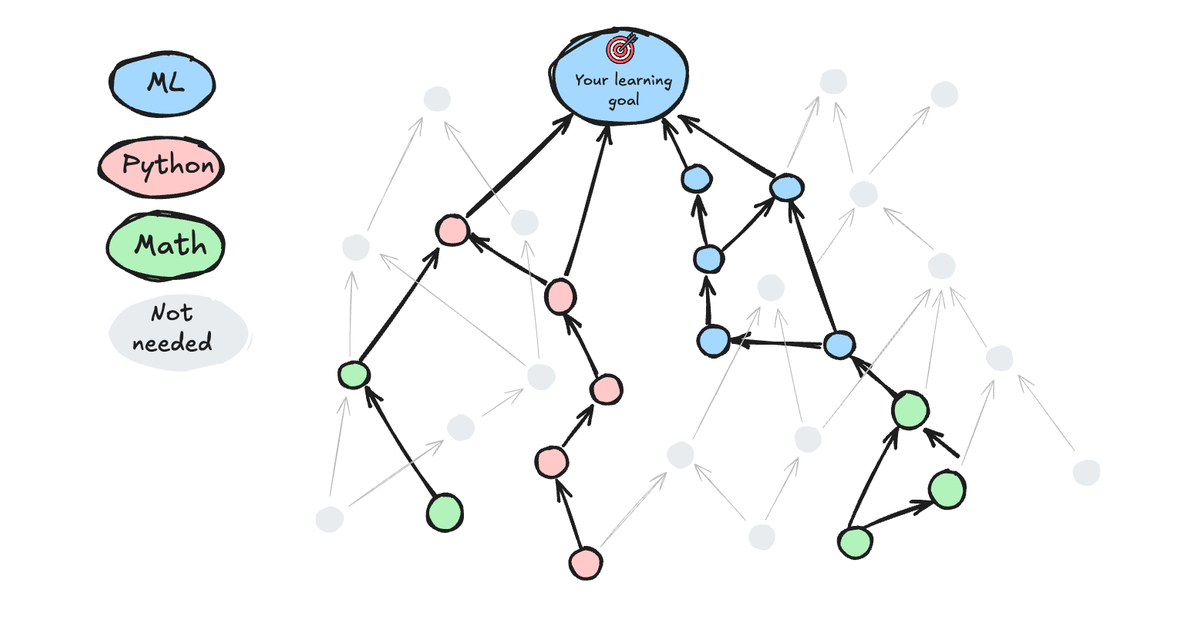
Traditional spaced repetition treats every concept as an island. But knowledge isn't flat - it's hierarchical. When you demonstrate mastery of an advanced topic, you're implicitly proving you remember its foundations. We built a system that understands this.
The problem with traditional spaced repetition
Spaced repetition is one of the most effective techniques for long-term retention. The core insight is simple: review material at increasing intervals, timed just before you'd forget it. Apps like Anki have made this accessible to millions.
But there's a fundamental limitation. Traditional systems treat each piece of knowledge as independent. Learn 500 concepts, and you'll eventually have 500 separate review schedules competing for your attention.
For hierarchical domains like programming, mathematics, or any technical field, this creates unnecessary overhead. Consider conditional logic in Python - you can't write an if-statement without understanding booleans. Or calculating a matrix determinant - it requires knowing about identity matrices. Yet traditional systems schedule separate reviews for each prerequisite, ignoring these dependencies entirely.
The review burden problem
As your knowledge grows, review queues become overwhelming. Learners either abandon the system entirely or spend more time on maintenance than new learning. This is why most people who start with spaced repetition don't stick with it.
Hierarchical Spaced Repetition: a structural solution
Nodeledge's curriculum is built on a knowledge graph- a directed structure where every topic is connected to its prerequisites. This isn't just for sequencing lessons. We use this same structure to make spaced repetition dramatically more efficient.
The key insight: demonstrating mastery of an advanced topic provides evidence about its prerequisites. If you can correctly evaluate conditional expressions, you clearly still understand how booleans work.
We call this credit propagation. When you successfully review an advanced topic, partial credit flows downward through the knowledge graph to reinforce its prerequisites. This means fewer explicit reviews while maintaining the same retention.
The system also handles failures intelligently. When you forget a foundational topic, the penalty propagates upward to topics that depend on it. This ensures that when cracks appear in your foundation, the dependent topics get flagged for earlier review.
How it works
Like most spaced repetition systems, HSRS uses exponential interval growth - each successful review roughly doubles the time until your next review. The key difference is that your repetition count can increase through indirect practice, not just direct reviews.
The propagation mechanics work as follows:
| Event | Direction | Rationale |
|---|---|---|
| Review pass | ↓ Down to prerequisites | Recalling T reinforces T's prerequisites |
| Review fail | ↑ Up to dependants | Forgetting T undermines topics that depend on T |
| Lesson pass | ↓ Down to prerequisites | Mastering T shows solid prerequisites (reduced weight) |
Credit from lesson passes is discounted because lessons include scaffolding - you're working with the material fresh in mind. Reviews are "cold recall" and receive full weight.
Key insight
Not all prerequisites are equally exercised when you practise an advanced topic. Some are central to the task, others merely tangential. Our system accounts for this - credit flows more strongly through relationships where the prerequisite is genuinely being used.
Additional refinements
Beyond credit propagation, HSRS includes several mechanisms to handle real-world learning patterns:
Early review discounting
Reviews completed before their scheduled date receive proportionally less credit. Recalling information that's still fresh doesn't strengthen memory as much as recalling information you're about to forget.
Overdue decay amplification
Failed reviews that are significantly overdue incur amplified penalties. Knowledge that has decayed badly requires more aggressive remediation.
Confidence tracking
Each topic tracks a "confidence" score based on historical consistency. Topics with high confidence (consistent successes) get longer intervals. Topics with low confidence (mixed results) get shorter intervals. Failures impact confidence more than successes - a single failure after five successes is meaningful signal.
Knock-out scoring for review prioritisation
When multiple topics are due for review, the system prioritises those with the highest "knock-out score" - topics that, when reviewed, will reinforce the most other due topics. This maximises efficiency during review sessions.
Real impact
The practical effect of HSRS is substantial. Consider a learning path with 100 topics arranged in a typical dependency structure. With traditional spaced repetition, you'd eventually face 100 independent review schedules.
With HSRS, reviewing the "leaf" topics at the frontier of your knowledge automatically maintains the foundation. In practice, this means:
• 30-50% fewer explicit reviews for the same retention level
• More time on new learning, less on maintenance
• Automatic identification of weak foundations before they cause problems
• Sustainable long-term practice - review queues don't grow unboundedly
This isn't just an incremental improvement. It's what makes spaced repetition viable for structured technical domains at scale.
Why this matters
Most online learning platforms focus exclusively on content delivery. You watch videos, complete exercises, maybe get a certificate. Then you forget 80% of it within weeks.
Nodeledge is built differently. We believe that retention is the product. A learning platform that doesn't ensure you actually remember what you learned has failed at its core purpose.
HSRS is our answer to making long-term retention practical. It's the technical foundation that lets us promise not just learning, but lasting mastery.
Built for mastery
HSRS is one piece of Nodeledge's approach to effective technical education. Combined with our knowledge graph curriculum, diagnostic testing, and practice-heavy lessons, it forms a complete system designed around how learning actually works.