If you've ever tried to learn machine learning, you know the feeling: you're halfway through a tutorial on neural networks when you realise you don't really understand matrix multiplication. Or you're debugging a Python script and discover your grasp of object-oriented programming was always a bit shaky. You thought you knew this stuff - but do you really?
This isn't your fault. It's a fundamental mismatch between how we learn and how technical knowledge actually works.
Technical knowledge is hierarchical
Subjects like mathematics, programming, and machine learning are hierarchical skill domains. They're not just collections of independent facts you can learn in any order. Instead, each concept builds on previous ones in a very specific way.
If you don't master the foundational content, you'll quickly come unstuck when you move onto the harder stuff. Or worse - something more insidious happens: you plateau and don't even realise why.
Think of it like building a tower. If the foundation is shaky, every floor you add makes the whole structure more unstable. Eventually, it collapses - or at best, you can't build any higher.
The solution: Prerequisite knowledge graphs
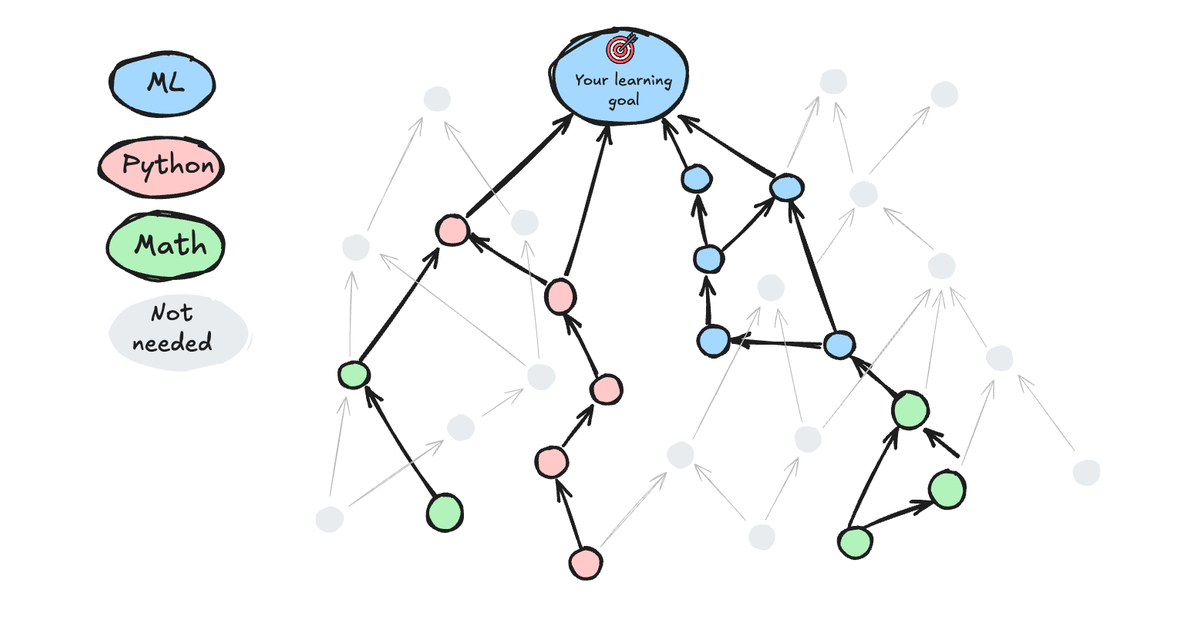
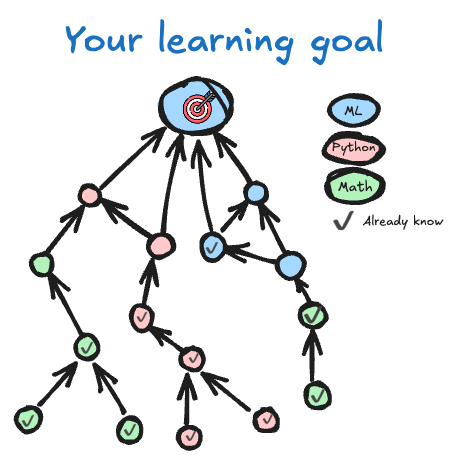
A powerful way to fix this is to build what's called a prerequisite knowledge graph. It's a map where every topic is a node, and every edge tells you which topics you need to master before moving on to the next one.
This structure isn't just theoretical - it creates a fine-grained picture of your knowledge fingerprint: the unique pattern of what you know, what you're shaky on, and what comes next.
In computer science terms, this is a Directed Acyclic Graph (DAG). Each concept points to the concepts that depend on it. You can't learn concept B until you've mastered concept A. The structure is explicit, trackable, and most importantly - it matches how knowledge actually works.
Mastery learning: Only progress when ready
This structure enables mastery learning, where you only progress after demonstrating mastery of the prerequisite topics. No more moving forward with gaps in your understanding. No more discovering months later that you never really understood the basics.
This matters immensely in fields like machine learning, where the prerequisites are often hidden or implicit - and scattered across different topics in mathematics and programming. It's actually a bit of a mess that no one wants to deal with.
Far easier for course creators to just assume every learner is a homogeneous entity with exactly the same knowledge fingerprint. But that's not reality.
Three ways knowledge graphs transform learning
With a prerequisite knowledge graph, we can do three powerful things:
- Build personalised learning paths
Since we've explicitly captured all the prerequisites for your goal, we can construct the exact path you need to follow. No guessing where to start.
- Diagnose what you already know
Through targeted diagnostic tests, we can identify which topics you've already mastered and skip them. No more slogging through entire courses "just in case."
- Tell you exactly what comes next
Your progress becomes visible and structured - not just "I watched a few YouTube videos." You know precisely what you need to master next and why it matters.
Respecting the structure of knowledge
At Nodeledge, we believe knowledge graphs are a differentiating technology that enables truly personalised learning. Not personalised in the sense of "we recommend videos based on what you clicked" - but personalised in the sense that the system understands your unique knowledge fingerprint and guides you accordingly.
It's time we stopped building wobbly towers and started building structured, goal-based knowledge that lasts.
Learning works best when it respects the structure of knowledge itself. Technical knowledge isn't a checklist. It's a graph - and if we ignore the edges, we get runtime errors in our learning.