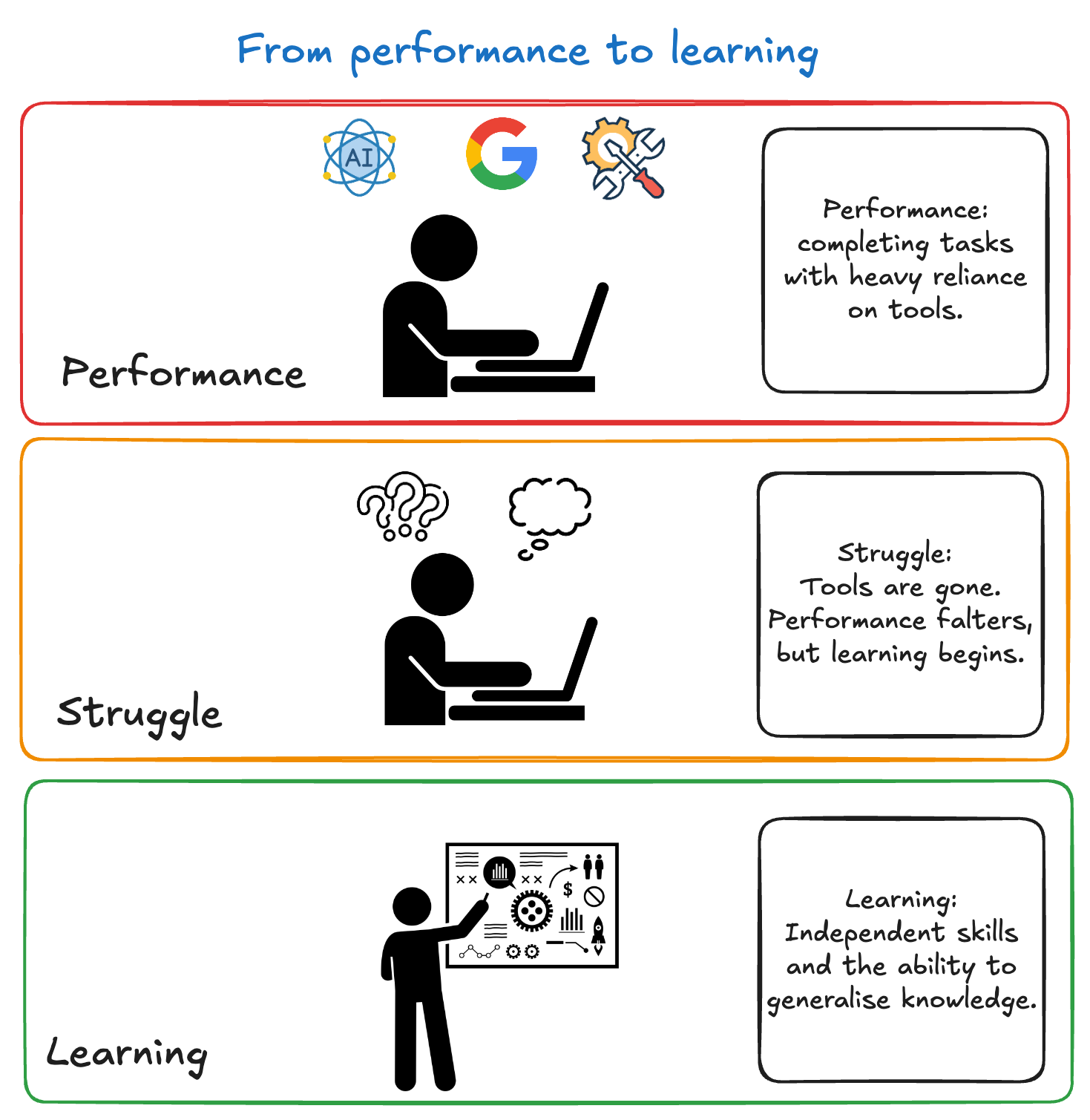
Have you ever found yourself stuck on a problem that looked only slightly different from what you've practised? You're not alone. The problem isn't your ability - it might be how you're learning. This post introduces a powerful, research-backed technique called interleaving that can transform your technical learning.
Understanding surface vs. deep structure
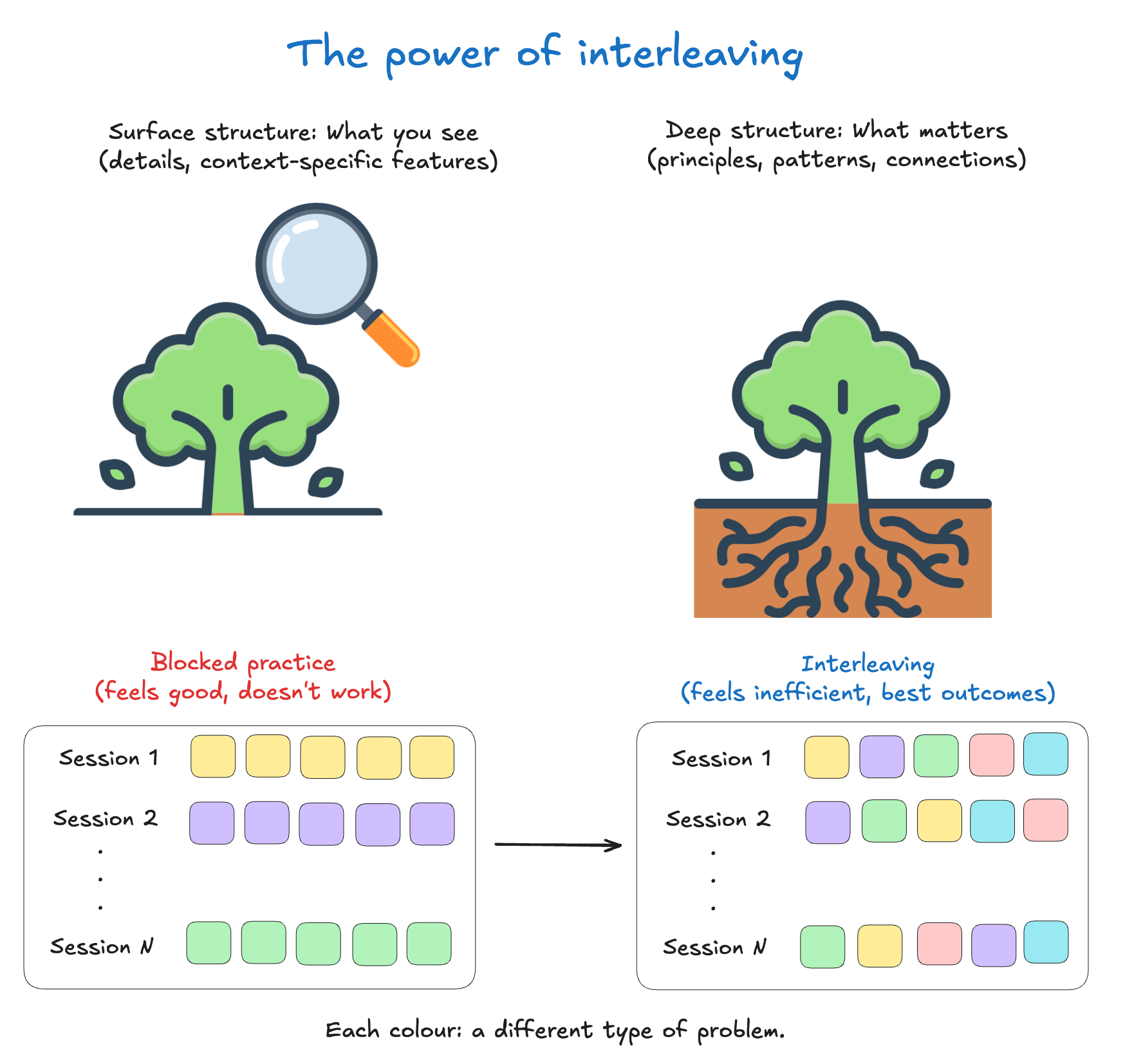
Research shows that beginners often focus on surface structure - the obvious details of a problem - because that's what they can easily recognise. In fact, early on in learning - it's often all we're able to recognise. Simply put, our working memory is already maxed out with the new concept and we have little attention left to divert elsewhere. Experts, however, can see deeper, identifying the principles that truly matter.
For example, Chi et al. (1981) showed that in physics, novices tend to group problems by surface features (e.g., ramps vs. pendulums), while experts group them by the underlying principles, like the conservation of energy. The same applies to coding. Beginners often focus on syntax alone, while mastery involves recognising deeper patterns like algorithm design, modularity or how the current code contributes to the whole system.
Blocked practice vs. interleaving
Part of the reason for this is that traditional learning methods often use blocked practice - repeating the same type of task until it's familiar. While this feels efficient, research shows it reinforces surface-level familiarity and fails to build transferable skills.
This is because effective problem-solving requires both identifying how to match a solution technique to a problem as well as applying that solution technique.
Interleaving solves this by mixing up problem types or skills in a single session, requiring learners to recognise the type of problem they're solving and apply the appropriate principle. This effortful process enhances retention and our problem-solving ability.
A common coding scenario: beginners may practice functions in isolation but struggle when combining them with loops and conditionals in real-world problems. Interleaving these concepts helps bridge that gap.
How to apply interleaving
- Aim to mix up your problem types in every practice session. For instance, if you're practising Python, solve a list comprehension problem, then a loop-based task, followed by a conditional logic problem. The switch will feel challenging but reinforces recognition and adaptability.
- Try to step back and focus on the principle behind the problem, not just on getting a solution out the door.
- Combine interleaving with spaced repetition (i.e. sequencing your learning through time) for even better results.
Codifying interleaving
Interleaving may feel harder at first, but it's a key learning technique when building real mastery. However, it should be used with care.
At Nodeledge, we've designed our learning paths to introduce interleaving thoughtfully. Early lessons focus solely on the topic being taught, ensuring you build a strong foundation without overloading your working memory.
As you progress, we carefully add interleaving into your practice, combining earlier concepts to help you recognise patterns and apply principles across different scenarios. This balanced approach ensures you gain deep mastery without feeling overwhelmed.