At Nodeledge, we care about efficiency in learning design. Not in the "hack your brain in ten minutes" sense, but in the sense of aligning with the architecture of human cognition. Cognitive Load Theory (CLT) gives us that map. It's one of the few ideas in educational psychology that changes how we actually build learning experiences.
CLT was developed by John Sweller in the 1980s, building on what cognitive psychologists had learned about the limits of human information processing. The core insight is simple but profound: our minds have a finite capacity for processing new information. Exceed that capacity, and learning stops. Instructional design either works with that constraint or wastes learners' effort fighting against it.
Here's the ABCDE - a five-part framework that captures CLT's essence.
A - Architecture
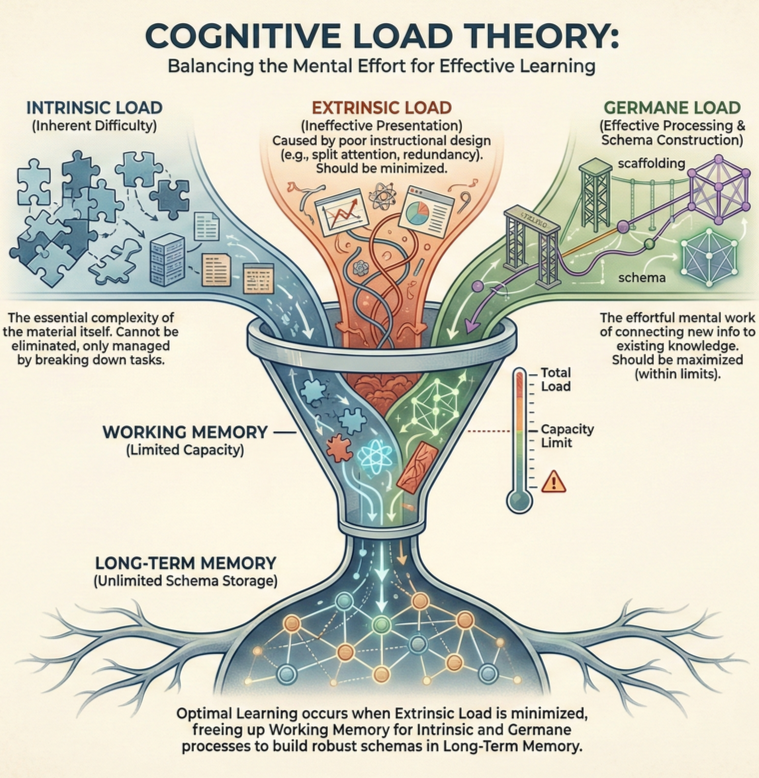
Human cognition has a strict bottleneck. Working memory is narrow and fleeting; long-term memory is vast and durable.
Learning happens when we construct and automate schemas that relocate knowledge into long-term storage. Instructional design's first job is to work within that bottleneck rather than pretend it doesn't exist.
B - Biology
We're wired to learn some things without effort: recognising faces, parsing speech, reading emotions. These are biologically primary skills - evolution sorted those out for us.
But most of what we teach - programming, algebra, model interpretation, even grammar - is biologically secondary. It doesn't come for free. It overloads working memory unless intentionally designed and scaffolded.
C - Categorisation
All cognitive load isn't bad.
- Intrinsic load is the unavoidable complexity of the material itself.
- Extraneous load is the waste introduced by poor design or distraction.
- Germane load is the productive mental work that builds connections and understanding.
Good instructional design reduces extraneous load and channels effort towards germane processing, so learners can spend their limited cognitive resources on what matters.
D - Domains
Expertise doesn't generalise well. There's no such thing as a generic "problem-solving" skill. What looks like transferable thinking is usually the fluent retrieval of domain-specific schemas.
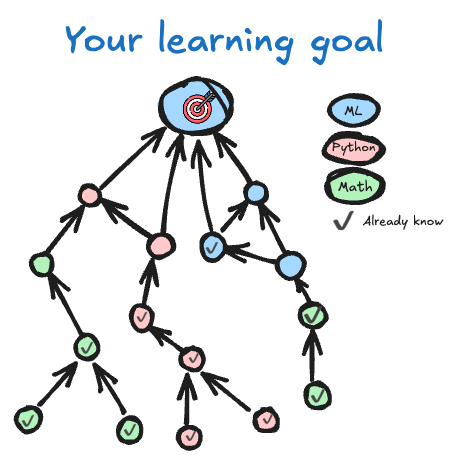
In Nodeledge, this is why mastery is scoped per topic. Each concept builds its own structure in long-term memory before being linked to others. That's how we build genuine expertise.
E - Elements
Every idea is made up of interacting elements. The more elements that must be processed simultaneously, the higher the cognitive load.
Good instruction manages this by scaffolding complexity: one interaction at a time, with increasing integration once earlier pieces are mastered. That sequencing is the design equivalent of good engineering - progressing from working subsystems to a coherent whole.
Bringing it together
CLT's recommendations are deceptively simple:
Reduce extraneous load.
Manage intrinsic load.
Design for germane load.
That's the art of making learning work with human cognition instead of against it.
Everything we do at Nodeledge - from our knowledge graphs to adaptive diagnostics - is built around this principle. It's not about grinding harder, but designing smarter.