What is Machine Learning?
Learning a rule from data rather than writing it: features and labels, training and generalisation, the main types of learning task, and fitting a first model to real data.
No account needed to read a lesson · 30-day money-back guarantee
See the full learning path7
lessons
60
practice questions
1
prerequisite lesson
See it taught
1 of the 7 lessons here is free to preview - the whole explanation and worked example, with no account and no email.
From the lesson
Lesson 04 · Core concepts in a machine learning problem
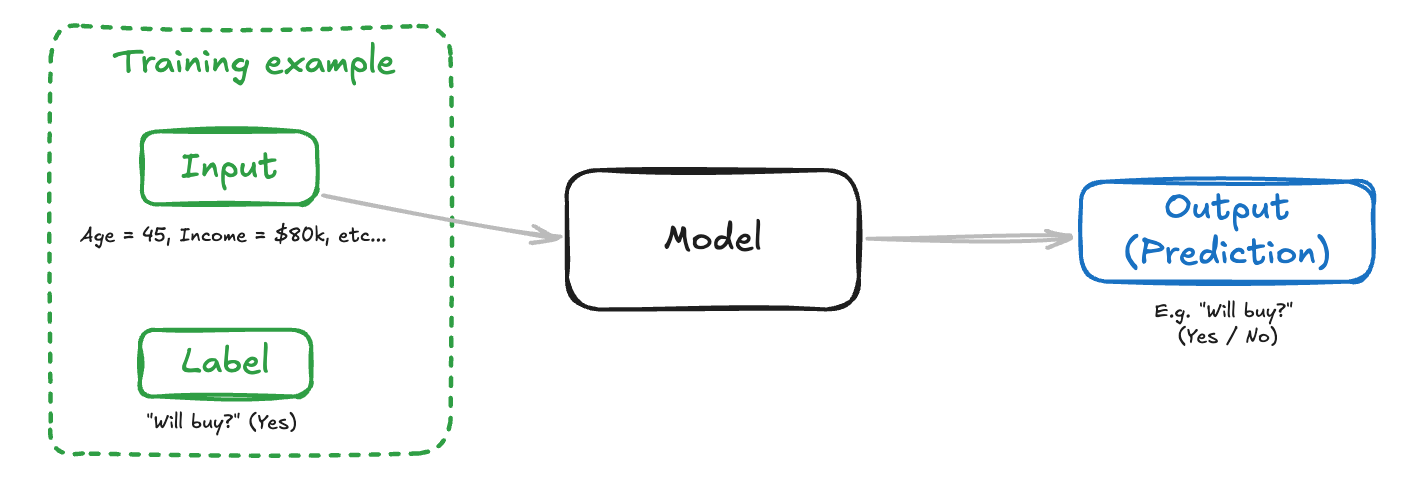
A figure from the lesson itself, not an illustration made for this page.
The 7 lessons
The 7 lessons in this unit. Expand any one to see what it covers. Each unlocks when its own prerequisites are passed.
01
Introduction to machine learning
6 questions
Introduction to machine learning
Learn what distinguishes machine learning from traditional rule-based programming, how machine learning systems learn from data and improve over time, and how this approach fits within the broader field of artificial intelligence as the dominant method for tasks requiring adaptability and pattern recognition.
Covers
What is machine learning?
Where does ML fit in the broader field of AI?
02
Introduction to the California Housing dataset
9 questions
Introduction to the California Housing dataset
Understand how the California Housing dataset represents real-world information as tabular data with rows as block groups and columns as numeric features, recognise different variable types, and see how visualising distributions with histograms reveals patterns in the data.
Covers
Tabular data: rows and columns
Types of variables
Visualising the variables
03
Fitting a simple ML model: predicting California house prices
9 questions
Fitting a simple ML model: predicting California house prices
See how a machine learning model can be trained to predict the median house value in Californian districts based on input features, and how its predictive accuracy is assessed using new data it has not seen before.
Covers
Fitting the model
The data
Model performance
04
Core concepts in a machine learning problem
Preview9 questions
Core concepts in a machine learning problem
Understand the fundamental structure of a supervised machine learning problem by identifying the roles of data (inputs and labels), the model and learning algorithm, and the distinction between the training and inference phases.
Covers
Data, inputs, outputs, and labels
Model and learning algorithm
Training vs inference
05
Types of learning tasks
9 questions
Types of learning tasks
Understand the main types of machine learning tasks by distinguishing between supervised, unsupervised, semi-supervised and reinforcement learning, and learn how supervised problems can be classified further as classification or regression based on the nature of the output.
Covers
Supervised vs unsupervised learning
Classification vs regression
Other learning paradigms
06
Framing real-world problems for machine learning
12 questions
Framing real-world problems for machine learning
Understand how to analyse real-world problems to determine whether machine learning is appropriate, frame problems as classification or regression based on the desired output, and identify suitable inputs, outputs, and learning setups for effective model design.
Covers
How ML framing changes with context
Identifying inputs, outputs, and learning setup
Choosing between classification and regression
Not every problem needs ML
07
Why generalisation is the goal in supervised learning
6 questions
Why generalisation is the goal in supervised learning
Understand why the primary aim of supervised learning is to build models that generalise well to unseen data, and how test sets are used to estimate generalisation error as opposed to training error.
Covers
The goal of supervised learning is generalisation
Generalisation error vs. training error
Where this unit sits in the curriculum
This unit is part of our A conceptual introduction to Machine Learning learning path, which contains 10 lessons. Every one of them is drawn below.
The diagnostic test lets you skip any lesson you already know, including the ones in this unit.
Hover any dot to name its lesson.
7 lessons in this unit
1 prerequisite lesson across the unit, counting every step back to the start
2 other lessons in the learning path - after this unit, or alongside it
Leads to: Vectors in Euclidean space
Start What is Machine Learning?
One subscription covers every learning path, and you can test out of anything you already know.
One subscription covers every learning path · 30-day money-back guarantee