Free preview
Core Machine Learning
Free preview
Core Machine Learning
Master the fundamentals
No surprise gaps
Actually remember it
Skip what you know
One subscription. All learning paths included.
Our content is best on a larger screen
Core concepts in a machine learning problem
Data, inputs, outputs, and labels
Explanation
Machine learning uses data to drive learning. A model becomes useful not because we explicitly tell it what to do, but because it sees enough examples to learn patterns and make predictions.
In the most common setup - supervised learning - we provide the model with a dataset of examples that include both the inputs and the correct outputs. These correct outputs are known as labels (or targets). By seeing many input-label pairs, the model learns how to produce the right output for a given input. Supervised learning is our focus for the remainder of this lesson.
Three core components structure this process:
- Inputs (features): The information the model is given - measurable attributes such as age, income, temperature, or pixel values in an image. The model uses these to make predictions.
- Outputs (predictions): What the model produces when given an input. Depending on the task, outputs could be numbers (e.g. a house price), categories (e.g. spam or not spam), or more complex structures like sentences or images.
- Labels (targets): The correct answers provided during training. By comparing the model's output with the correct label, the system can adjust and improve. Labels are the feedback mechanism that tells the model how well it is doing.
Warning
Labels are not present when the model is deployed (otherwise we would not need a model!). They exist only to guide learning during training.
We can visualise this for a single training example as:
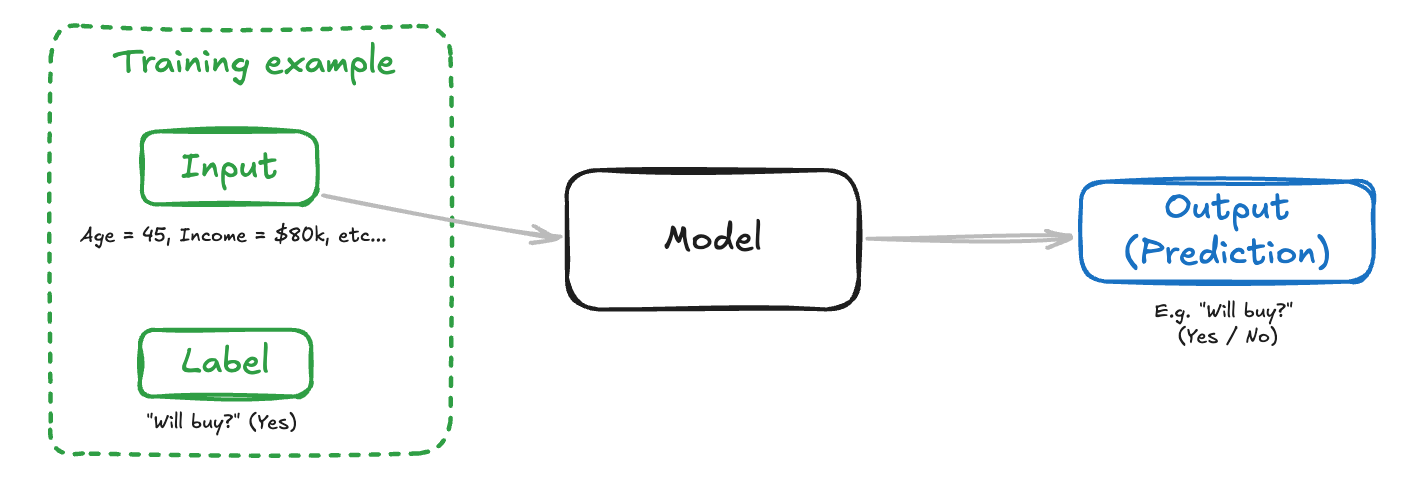
In general, the more relevant and representative the data, the more effective the learning.
Example
Which of the following best represents inputs and outputs in a supervised machine learning task to predict house prices, given information about each house (square footage, number of rooms, location)?
- Input = house price; output = square footage.
- Input = square footage, number of rooms, location; output = house price.
- Input = square footage, number of rooms, location; output = mortgage amount.
- Input = square footage, number of rooms, location; output = average price of houses on same street.
Answer: Option 2
Explanation
The inputs are the information we have about each house (square footage, number of rooms, location), and the output is what the model predicts (house price). During training, we would show the model many such examples paired with correct labels (the actual prices) so it can learn the relationship.
Practice questions
3 questions
In a supervised machine learning problem, what do we typically call the information we provide the model in order to make a prediction?
Select the correct answer:
+ 2 more questions
Model and learning algorithm
Explanation
Once we have defined the inputs and outputs of a problem, the next step is to learn the relationship between them. This is where the model and learning algorithm come in.
- A model is the system that makes predictions. It takes inputs and produces outputs. Whether simple or complex, its job is always the same: map inputs to outputs.
- The learning algorithm is the method by which the model improves. It examines examples of inputs paired with correct labels and adjusts the model to reduce the difference between its predictions and the correct answers.
We describe the model as having parameters - adjustable parts that control how it makes predictions. The learning algorithm updates these parameters to reduce the training error (the mistakes the model makes on training examples).
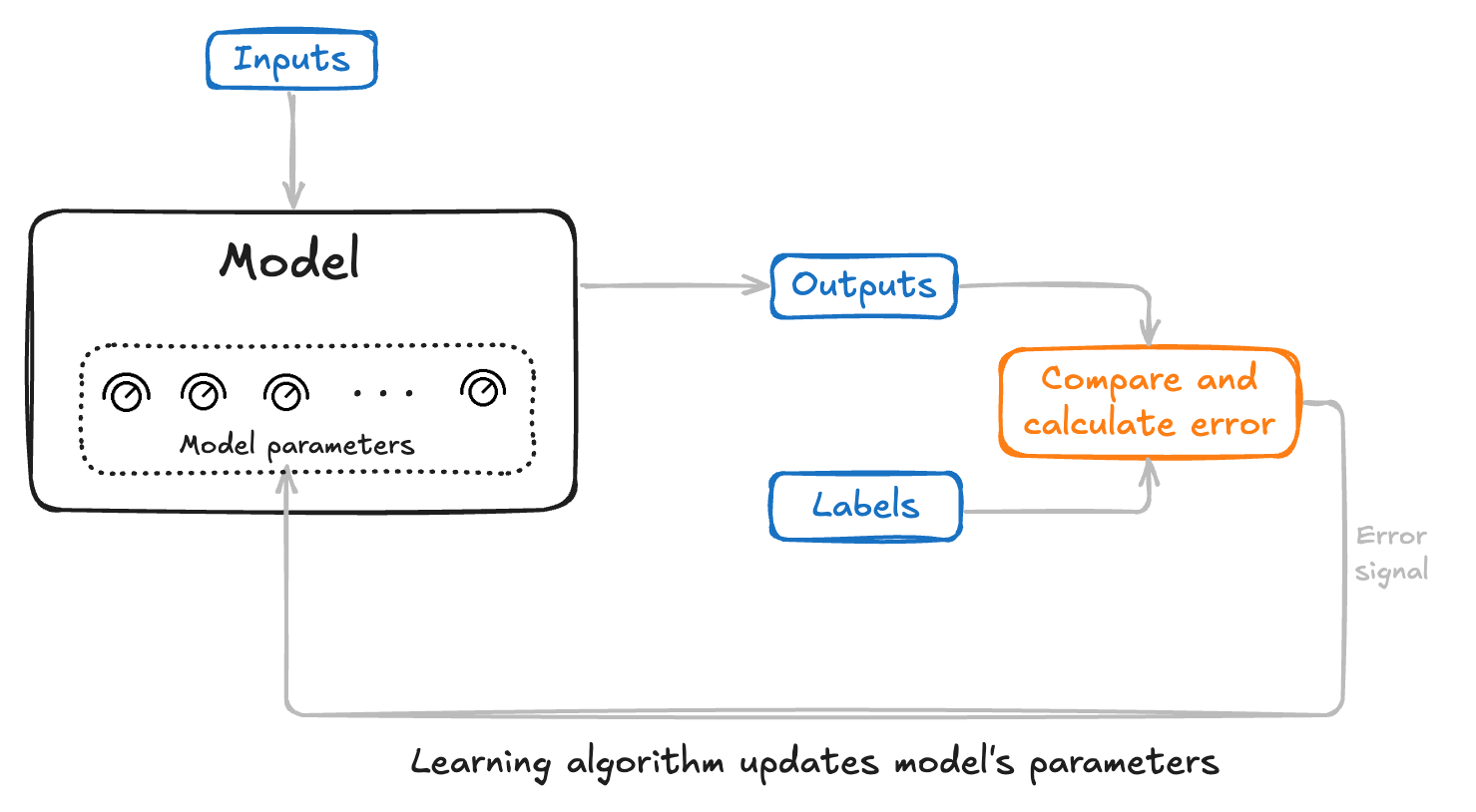
For example, when we fit a LinearRegression model to the California Housing dataset, the model is the linear regression system that predicts house prices from input features. The learning algorithm adjusts its parameters so that predictions are as close as possible to the actual house prices in the training data.
Example
A company wants to predict whether a loan application should be approved based on age and income. What role does the model play?
- It stores all previous loan applications and retrieves similar ones.
- It defines a fixed rule that says people over 25 automatically qualify.
- It learns a relationship between age/income (inputs) and approval (output).
- It manually checks each case against legal guidelines.
Answer: Option 3
Explanation
The model learns from data - in this case, historical loan decisions - to find patterns that relate inputs (age, income) to outputs (approval decision). The learning algorithm helps the model improve its accuracy as it sees more examples.
Practice questions
3 questions
During the training of a supervised machine learning model, what does the learning algorithm do?
Select the correct answer:
+ 2 more questions
Training vs inference
Explanation
Supervised machine learning systems operate in two distinct phases: training and inference.
- Training is when the model learns. It receives examples with known inputs and labels, and uses a learning algorithm to reduce the training error. This is the phase where the model gains its "knowledge".
- Inference is when the model makes predictions on new, unseen data. The model has already been trained - we simply feed it inputs and it returns predictions. This phase is also commonly called prediction.
During training, the model uses feedback (labels) to learn. During inference, it must apply what it has learned without any feedback - just like a student taking an exam.
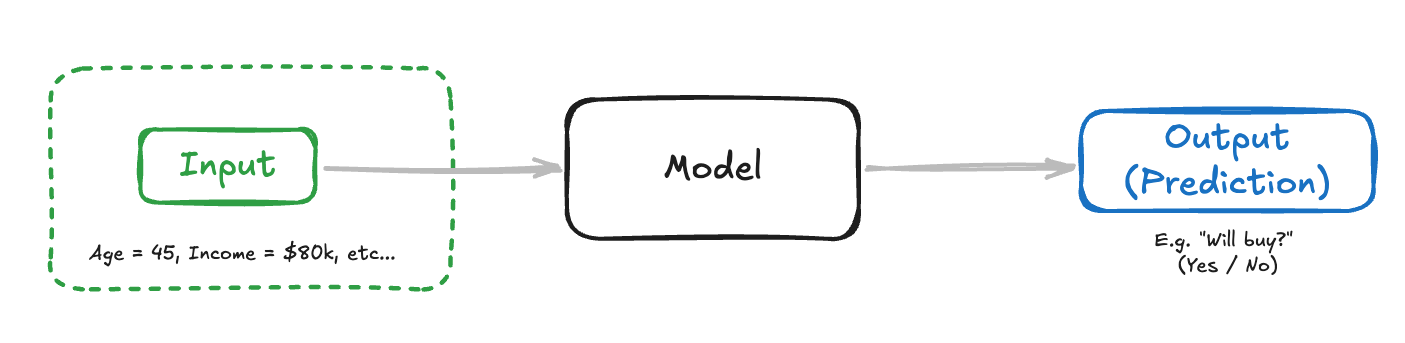
This distinction also matters in practice: we may train only once (or relatively few times), but run inference millions of times once the model is deployed. Training can therefore be resource-intensive, while we typically want inference to be fast and lightweight.
Example
A speech recognition model is trained on thousands of voice samples. Later, it is used to transcribe live conversations. What phase is the model in during transcription?
- Training - because it is still learning from new conversations.
- Evaluation - because it is being graded.
- Inference - because it is applying what it learned to new inputs.
- Supervision - because a human is using it.
Answer: Option 3
Explanation
During transcription, the model is making predictions based on what it already learned during training. It’s not being updated or corrected - it’s applying its existing knowledge to new, unseen data. As such we call this phase inference.
Practice questions
3 questions
In supervised machine learning, what is the primary difference between training and inference?
Select the correct answer:
+ 2 more questions