If you think you're bad at maths, you're almost certainly wrong. You don't have a maths brain problem - you have a gaps-in-your-prerequisite-knowledge problem.
It rarely feels that way. When you hit a wall on a topic - say, calculus - it feels like the topic itself is the problem. The chapter won't make sense no matter how many times you re-read it. The obvious conclusion is that your brain can't do this stuff. That conclusion is almost always wrong.
You're not short on horsepower
Mathematical ability is mostly built, not innate. Working memory and processing speed differences are real, and they affect how fast you can progress - but they're rarely what's actually blocking you. Missing foundations are.
The struggling learner isn't short on cognitive horsepower; they're short on rock-solid foundations. That should be comforting: gaps in your knowledge can be diagnosed and filled. Brains, not so much.
Knowledge is hierarchical - more than you think
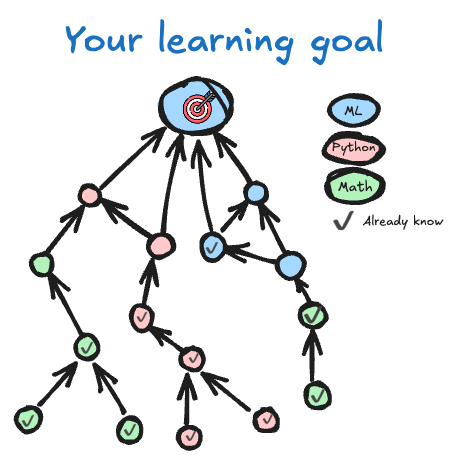
Maths has an unusual property: knowledge is strictly hierarchical. Every concept loads on the ones below, and the tower only stands if every layer holds.
You might be able to fake your way through other subjects with general literacy and a good memory for quotes. You cannot fake your way through advanced mathematics if you're confused about the basics. A weak grasp of fractions will eventually sink your calculus. A fuzzy sense of what a vector is will stop you understanding eigenvalues. Every concept sits on the prerequisites below it - and a gap at the base compromises everything above it.
Why calculus is where it all falls apart
A familiar story: "I was fine until calculus, then it was just too much." It's one of the most common narratives in maths education. And it's almost always misdiagnosed.
Calculus is the subject that most reliably exposes missing fluency in algebra and trigonometry. It leans hard on those layers for the first time, and any weakness stops being tolerable. When you sit down to differentiate a product of trig functions, you're not just doing calculus - you're doing calculus on top of algebra on top of trigonometry on top of exponents. If any of those layers wobbles, the whole thing collapses.
The calculus itself is rarely the problem. Most people who think they're stuck on a topic are stuck on a missing prerequisite for it. They re-read the chapter twenty times and feel stupid. They needed to go back to factoring.
Stop grinding. Start diagnosing.
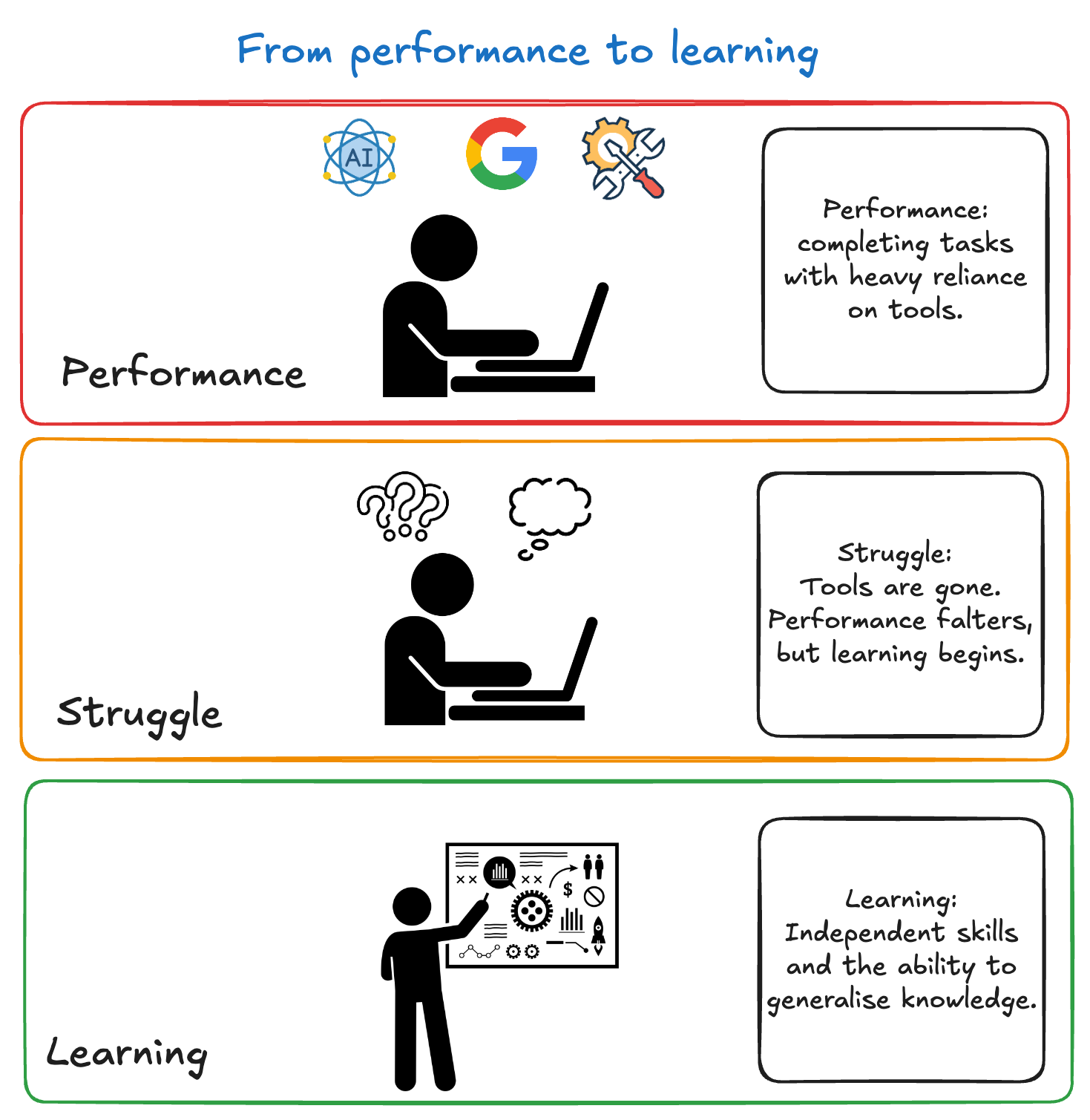
This is a structural problem, not a willpower problem. Grinding harder on the layer above a missing prerequisite does not work - it just makes you tired and convinces you that you're the problem.
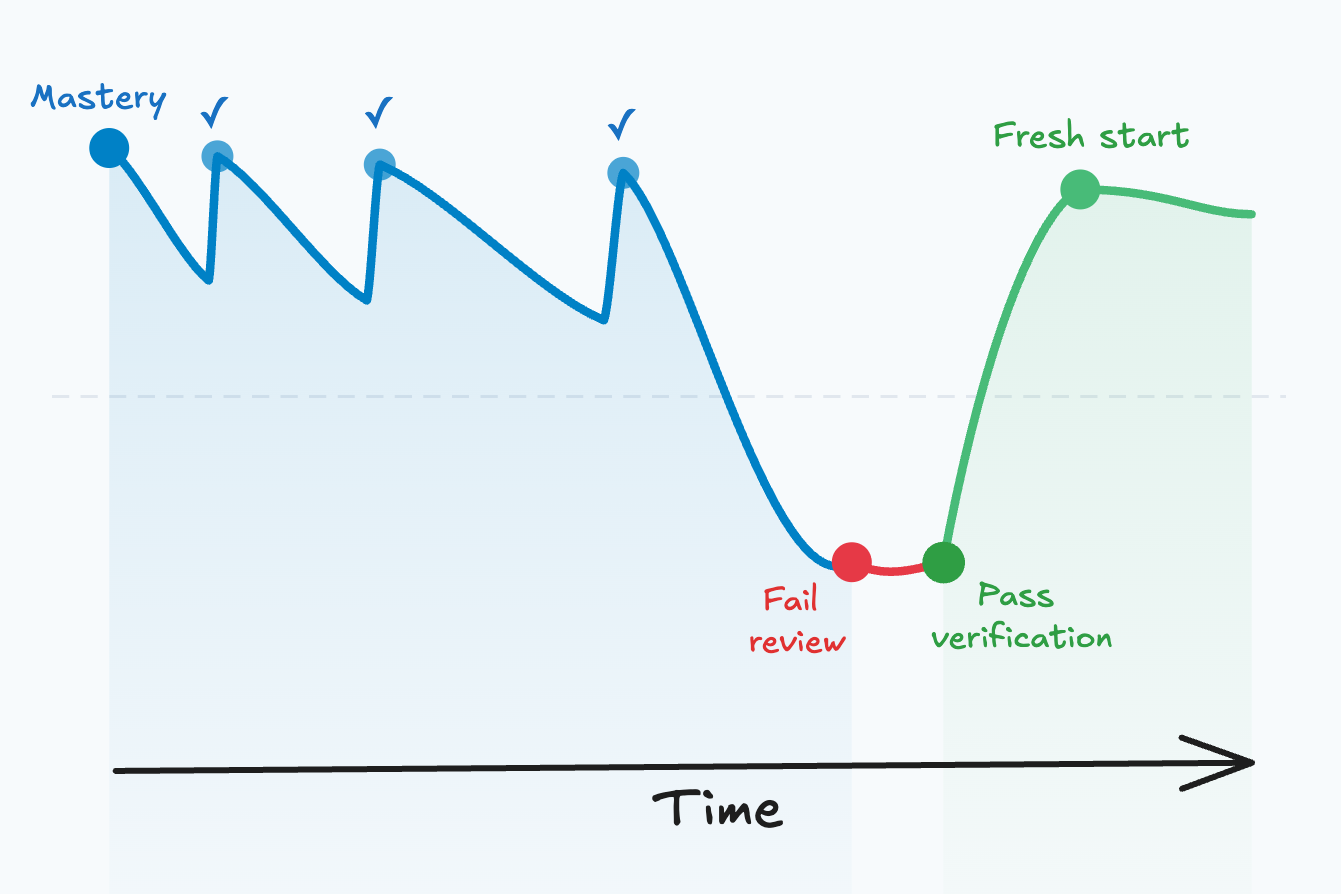
The fix is to find the load-bearing layer that's missing and rebuild from there. That means two things. First, you need a way to diagnose which foundational topic is actually compromised - not obvious if you've been operating with shaky knowledge for years. Second, you need something to stop you progressing past the gap until you've genuinely filled it - because pretending the gap isn't there is what caused the problem in the first place.
The gap is the problem. Pretending it isn't is what made you "bad at maths" in the first place.
How Nodeledge handles this
Nodeledge treats mathematics (and every other technical subject) as an explicit dependency graph. Every topic has its prerequisites spelled out, and mastery of those prerequisites is a gate, not a suggestion. You don't get to start differentiating until your algebra is actually solid.
When you join, a diagnostic test locates the gaps. You don't re-learn what you already know; you get straight to the topics you're shaky on, in the order the graph demands. Each lesson is short, testable, and either passes or it doesn't - no hand-waving. And because the graph knows what depends on what, anything you later struggle with can be traced back to the exact foundational layer that needs more work.
It's not a faster way to do the same thing. It's the only way to stop building on sand.